Automated call center solutions are transforming how businesses handle customer conversations. By combining AI-enabled customer service for growth with intelligent systems like an AI voice bot, modern contact centers blend automation, smart routing, and live agents to deliver faster, more consistent support at a lower cost.
When done well, automation does not replace the human touch; it amplifies it. Routine tasks are handled instantly by software, while your agents focus on high-value, complex, and emotionally sensitive interactions that move relationships forward.
At the heart of this transformation is intelligent cloud-based infrastructure for AI, which allows organizations to scale operations seamlessly while leveraging data-driven insights. This approach ensures that customer interactions are efficient, accurate, and personalized, all without overwhelming IT resources.
Equally important is next-generation computing innovations, which empower call centers to process complex workflows, integrate multiple communication channels, and optimize real-time decision-making. By harnessing advanced computing technologies, businesses can offer a smoother and more responsive customer experience.
AI-driven customer engagement strategies are reshaping the way businesses approach marketing. Automated call centers not only capture valuable behavioral insights but also help design highly targeted campaigns, enabling marketing teams to deliver more personalized, meaningful experiences that strengthen customer loyalty and drive growth.
Beyond marketing, intelligent financial AI solutions help organizations monitor transactions, detect patterns, and manage risks while delivering accurate and secure support for customers handling sensitive financial matters. AI-enhanced systems reduce errors and enable agents to focus on providing advisory services rather than routine verification tasks.
Together, these elements, cloud-based AI infrastructure, advanced computing technology, marketing-focused AI tools, and financial AI applications, create a unified ecosystem where automated call center solutions enhance both operational efficiency and customer satisfaction. By integrating these technologies, businesses are better positioned to thrive in a competitive, rapidly evolving market.
What Are Automated Call Center Solutions?
Automated call center solutions are technologies that handle parts of the customer interaction lifecycle with minimal human intervention. They help manage incoming and outgoing calls, route customers, collect information, and often resolve issues end to end without a live agent.
These solutions typically combine several capabilities:
- Call routing and distributionto send each caller to the right agent or automated flow.
- Interactive Voice Response (IVR)menus that let customers use voice or keypad inputs to self-serve.
- AI and natural language understandingthat let customers speak naturally instead of “Press 1, Press 2”.
- Outbound dialersthat automate proactive calls for reminders, renewals, and campaigns.
- Analytics and reportingthat show performance, trends, and opportunities for improvement.
The result is a smarter, more efficient contact center that scales easily and delivers consistently high service levels.
Top AI-Powered Call Center Solutions for Enhanced Customer Service
When choosing the right automated call center solution, businesses need a platform that combines AI, ease of use, and scalability. Here’s a list of top providers in the industry:
- Bright Pattern –
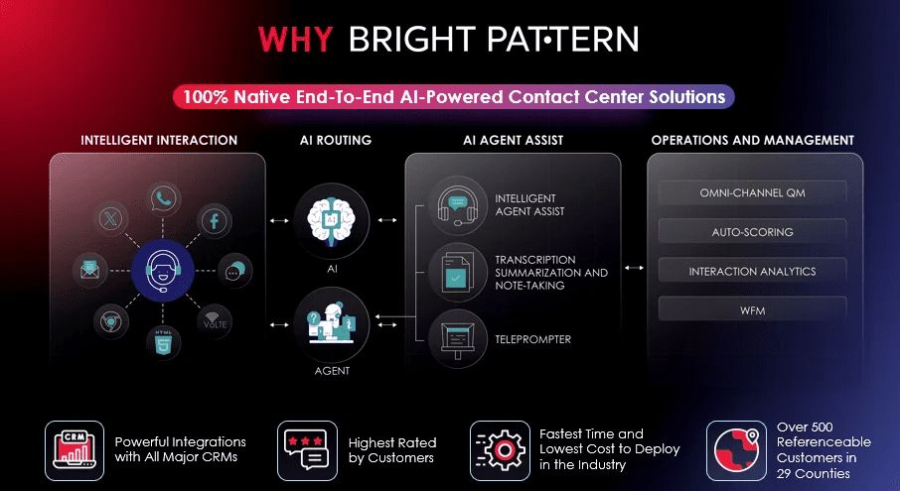
Bright Pattern stands out as a comprehensive AI-enabled customer service platform that delivers seamless omnichannel support. Its intuitive interface, advanced AI voice bot capabilities, and intelligent routing ensure faster response times and higher customer satisfaction. Bright Pattern’s automated workflows empower agents to focus on complex, high-value interactions while routine tasks are handled instantly. With robust analytics and cloud-based infrastructure, it helps organizations scale efficiently and drive growth through smarter customer engagement.
- Genesys – Known for its powerful AI-powered routing and predictive engagement features, Genesys helps businesses optimize both agent performance and customer experience.
- Five9 – Five9 combines cloud-based contact center technology with AI insights to automate workflows, improve agent productivity, and enhance customer satisfaction.
- Talkdesk – Talkdesk integrates AI and automation to streamline call center operations, offering advanced reporting and intelligent customer routing.
- NICE inContact – NICE inContact provides a flexible AI-driven platform that supports omnichannel communication and predictive analytics to optimize call center performance.
- Zendesk – Zendesk leverages AI tools to automate ticketing, route inquiries efficiently, and deliver more personalized support across channels.
- Avaya – Avaya’s solutions focus on AI-enhanced communication and workforce optimization, helping call centers improve efficiency and engagement.
- Cisco Contact Center – Cisco combines AI, cloud infrastructure, and analytics to deliver intelligent customer experiences and streamline agent workflows.
- RingCentral Contact Center – RingCentral integrates AI-based tools with cloud telephony to provide omnichannel support and actionable insights for better decision-making.
- 8x8 Contact Center – 8x8 offers AI-driven automation and analytics to boost productivity, enhance customer engagement, and support seamless multichannel communication.
Key Components of Automated Call Center Solutions
1. Interactive Voice Response (IVR)
AnIVR systemanswers calls, presents menu options, and lets customers complete tasks without waiting for an agent. Modern IVRs go beyond simple “Press 1” menus by supporting natural language and personalized experiences.
- Collects customer details before they reach an agent.
- Authenticates callers for secure account access.
- Handles routine tasks like balance checks, order status, or appointment changes.
- Provides targeted messages and offers based on caller history.
2. Automatic Call Distribution (ACD)
Automatic Call Distribution (ACD)routes incoming calls to the best available resource. Instead of random or manual transfers, ACD uses rules and real-time data to connect each caller with the right agent or workflow.
- Routes by skills, language, or department.
- Balances workload across teams and locations.
- Honors service levels and priority customers.
- Integrates with IVR and CRM for context-driven routing.
3. AI-Powered Virtual Agents and Voicebots
Virtual agentsandvoicebotsuse AI to handle natural conversations over the phone. Customers can explain what they need in their own words, and the system responds conversationally.
- Understands spoken or typed requests using natural language processing.
- Handles end-to-end tasks like password resets, address changes, or order updates.
- Hands off seamlessly to a live agent when needed, passing along full context.
- Operates 24 / 7 without requiring breaks or shift changes.
4. Outbound Dialers and Campaign Automation
Automated outbound dialersstreamline proactive outreach, making it easier to connect with customers at scale without overloading your team.
- Triggers follow-up calls based on events, such as new sign-ups or renewals.
- Automates reminders for appointments, payments, and deliveries.
- Supports sales campaigns with call lists, pacing, and automatic retries.
- Captures outcomes and updates your CRM automatically.
5. Workforce Management and Automation
Workforce management (WFM) toolshelp you plan staffing, schedule agents, and align resources with demand. With automation, this process becomes more precise and less time-consuming.
- Forecasts call volumes using historical trends.
- Builds optimized schedules that meet service levels.
- Automates adherence tracking and intraday adjustments.
- Helps reduce overtime and underutilization.
6. Analytics, Reporting, and Quality Management
Analytics and quality toolstransform raw call data into actionable insights. They reveal what works, what needs attention, and where automation can drive even more value.
- Real-time dashboards for queue lengths, wait times, and service levels.
- Historical reports showing patterns and performance by team, channel, or campaign.
- Call recording and evaluation for coaching and quality assurance.
- Speech analytics to identify frequent issues, sentiment, and training needs.
Business Benefits of Automated Call Center Solutions
When you combine these components strategically, the impact on your business can be substantial. Below are the major benefits organizations typically see.
1. Lower Operating Costs Without Sacrificing Quality
Automation handles a high volume of repetitive, low-complexity interactions at a fraction of the cost of live calls.
- Fewer manual steps per interaction.
- Reduced call handling times for agents.
- Less need for aggressive headcount growth as call volumes rise.
- More predictable and controllable cost structure.
2. Faster Response and Shorter Wait Times
Customers value speed. Automated solutions keep queues moving and help customers self-serve instantly, even during peak periods.
- IVR and virtual agents answer immediately, 24 / 7.
- Smart routing reduces transfers and dead ends.
- Callbacks and virtual hold options replace frustrating hold music.
- Proactive outbound reminders reduce inbound spikes.
3. Higher Customer Satisfaction and Loyalty
When customers reach the right resource quickly and resolve issues on the first try, satisfaction rises. Automated systems support this in several ways.
- Personalized journeys based on customer history and preferences.
- Consistent messaging and processes, regardless of channel or agent.
- Clear, predictable paths to resolution.
- Continuous improvement driven by data and analytics.
4. Better Agent Experience and Productivity
Automation helps your team work smarter, not harder. Instead of juggling repetitive tasks, agents can focus on complex cases that require human judgment and empathy.
- Automated screen pops show customer data the moment a call connects.
- Routine after-call work is minimized with auto-logging and templates.
- Guided workflows and knowledge suggestions reduce effort.
- Less burnout from repetitive, transactional calls.
5. Easy Scalability as Your Business Grows
As call volumes increase, automated call center solutions let you scale without linearly increasing headcount and infrastructure.
- Cloud-based platforms can add capacity quickly.
- Virtual agents handle surges without extra staffing.
- Routing rules adapt as you expand products, regions, or teams.
- Consistent processes across locations and time zones.
6. Stronger Compliance and Security
Automation reinforces compliance by building policies directly into workflows and scripts, reducing the risk of human error.
- Standardized disclosures and call flows.
- Automated consent capture and documentation.
- Role-based access and logging of system activity.
- Secure handling of sensitive data via self-service IVR where appropriate.
Common Use Cases for Automated Call Center Solutions
Automation fits a wide range of business scenarios. Here are some common and high-impact use cases.
Customer Service and Support
- Account and billing inquiries.
- Order status and delivery tracking.
- Password resets and profile updates.
- Product troubleshooting and FAQs.
Sales and Revenue Generation
- Lead qualification via automated outbound calls.
- Warm transfers from virtual agents to sales specialists.
- Automated callbacks for interested prospects.
- Renewal and upsell campaigns at scale.
Collections and Payments
- Automated payment reminders and confirmations.
- Self-service payment processing via IVR.
- Segmentation-based outreach for different risk groups.
- Real-time updates to balances and payment statuses.
Appointment-Based Businesses
- Appointment scheduling and rescheduling via phone menus or virtual agents.
- Automated reminders to reduce no-shows.
- Waitlist and callback management.
- Feedback collection after visits or consultations.
Industry Examples
|
Industry |
Example Automated Use Case |
|
Banking and financial services |
Balance checks, card activation, fraud alerts, loan application status. |
|
Healthcare |
Appointment reminders, prescription refills, pre-visit instructions. |
|
Retail and e-commerce |
Order tracking, returns initiation, product availability checks. |
|
Telecommunications |
Plan changes, usage updates, outage notifications, technical resets. |
|
Travel and hospitality |
Booking confirmations, flight status, check-in support, loyalty updates. |
Essential Features to Look for in Automated Call Center Solutions
Choosing the right platform is easier when you know which features truly move the needle. The most valuable systems typically include the following capabilities.
1. Omnichannel Support
Even if your initial focus is voice calls, customer journeys often span multiple channels.
- Consistent experiences across phone, email, chat, and messaging.
- Shared customer context so customers never have to repeat themselves.
- Integrated routing and reporting across all touchpoints.
2. Easy-to-Design Workflows
Automation should empower your operations and CX teams, not lock you into rigid code-heavy setups.
- Visual flow builders for IVR and virtual agent scripts.
- Drag-and-drop routing logic and conditions.
- Reusable templates for common journeys and campaigns.
3. CRM and Business System Integrations
Automation is most powerful when it works with your existing data and tools.
- Bi-directional sync with CRM and ticketing systems.
- Real-time access to customer profiles, orders, and cases.
- Automatic logging of calls, outcomes, and notes.
4. Intelligent Routing and Personalization
Smart routing delivers better experiences and stronger outcomes.
- Skills-based and priority-based routing.
- Routing by customer value, segment, or language.
- Dynamic messages and offers based on history and behavior.
5. AI and Machine Learning Capabilities
AI capabilities open the door to more natural interactions and continuous optimization.
- Natural language understanding for speech and text.
- Recommendation engines for next best action or offer.
- Predictive models for call volume and staffing.
- Automated quality and sentiment analysis.
6. Robust Analytics and Reporting
You cannot improve what you cannot measure. Strong analytics are essential for tuning automation over time.
- Real-time visibility into queues, SLAs, and agent performance.
- Self-service and containment rates for automated flows.
- Customer satisfaction and sentiment trends.
- Root-cause insights that support process improvement.
How to Implement Automated Call Center Solutions Successfully
Rolling out automation is most effective when you take a phased, outcome-focused approach. Below is a practical roadmap.
Step 1: Define Clear Goals and Metrics
Start by identifying the business outcomes that matter most. Typical goals include:
- Reducing average handle time or queue time.
- Increasing first contact resolution.
- Improving customer satisfaction scores.
- Deflecting a percentage of calls to self-service.
Translate these goals into concrete metrics with baseline values so you can measure progress.
Step 2: Map Current Journeys and Identify Automation Opportunities
Review your existing call flows and interaction types.
- List the top reasons customers contact your call center.
- Identify repetitive, rules-based tasks that do not require human judgment.
- Highlight pain points, such as long transfers or manual lookups.
These areas often deliver the fastest wins when automated.
Step 3: Prioritize High-Impact, Low-Complexity Use Cases
Rather than automating everything at once, focus on quick wins that demonstrate value.
- Balance potential impact on cost and CX against implementation effort.
- Choose use cases with clear rules and data sources.
- Plan a pilot that can scale once proven.
Step 4: Design Human-Centered Automated Journeys
Effective automation feels effortless to the customer. A few design principles help achieve this.
- Use simple, conversational language.
- Offer an easy path to a live agent at key points.
- Confirm important actions clearly before completion.
- Personalize prompts with known customer data.
Step 5: Train and Enable Your Agents
Your agents are critical partners in automation success.
- Explain how automation will support their work and reduce repetitive tasks.
- Train agents on new handoff processes from virtual agents or IVR.
- Share early results so teams can see tangible benefits.
Step 6: Launch, Measure, and Continuously Improve
Once your initial automated flows are live, use data and feedback to refine them.
- Monitor key metrics closely after launch.
- Review recordings and transcripts to spot friction points.
- Iterate prompts, routing rules, and escalation paths.
- Gradually expand automation into new use cases.
Metrics That Show Automation Is Working
Tracking the right metrics makes it easy to demonstrate the value of your automated call center solutions.
|
Metric |
What It Indicates |
Automation Impact |
|
Average speed of answer (ASA) |
How quickly customers reach a resource. |
Automation reduces reliance on agent availability. |
|
Self-service or containment rate |
Percentage of contacts resolved without an agent. |
Higher rates show automation is solving real issues. |
|
First contact resolution (FCR) |
Issues resolved on the first interaction. |
Smart routing and contextual data improve FCR. |
|
Average handle time (AHT) |
How long agent-handled calls take. |
Pre-call data collection and guided workflows cut time. |
|
Customer satisfaction (CSAT) or NPS |
Perceived experience and loyalty. |
Shorter waits and smoother journeys boost scores. |
|
Cost per contact |
Average cost to resolve an interaction. |
Automation lowers cost without sacrificing quality. |
Frequently Asked Questions About Automated Call Center Solutions
Will automation replace my agents?
Automation is designed toaugmentyour agents, not replace them. It takes over repetitive, predictable tasks so your human team can focus on higher-value work, complex problem solving, and relationship building. Most organizations find that automation makes agent roles more engaging and impactful.
How much of my call volume can realistically be automated?
The percentage varies by industry and complexity of interactions, but many organizations successfully automate a meaningful share of routine contacts, such as status checks, simple updates, and common questions. A phased approach lets you steadily increase coverage as customers grow comfortable with self-service.
Do customers actually like automated systems?
Customers appreciate automation when it isfast, clear, and helpful. If automated journeys are well designed and offer an easy path to a live agent, many customers prefer them for simple tasks because they avoid wait times and get quick answers.
How long does implementation typically take?
Timelines depend on scope and integration needs. Many organizations roll out initial automated flows in weeks, then expand capabilities over time. Using prebuilt templates, visual design tools, and existing integrations can accelerate deployment significantly.
What skills do we need in-house to manage automation?
Operations leaders, supervisors, and CX specialists often take ownership of automation design and tuning. Modern platforms are built so non-technical users can manage call flows, prompts, and routing, with support from IT for integrations and governance.
Turning Your Call Center into a Strategic Advantage
Automated call center solutions give you the power to serve more customers, more efficiently, while lifting satisfaction and empowering your team. By combining intelligent self-service, smart routing, and data-driven optimization, your contact center can shift from a cost center into a strategic growth engine.
When you focus on human-centered design, clear goals, and continuous improvement, automation becomes a powerful ally for both your customers and your agents. The organizations that embrace it thoughtfully are setting a new standard for fast, reliable, and delightful customer service.
